

Balanço
Rockaby
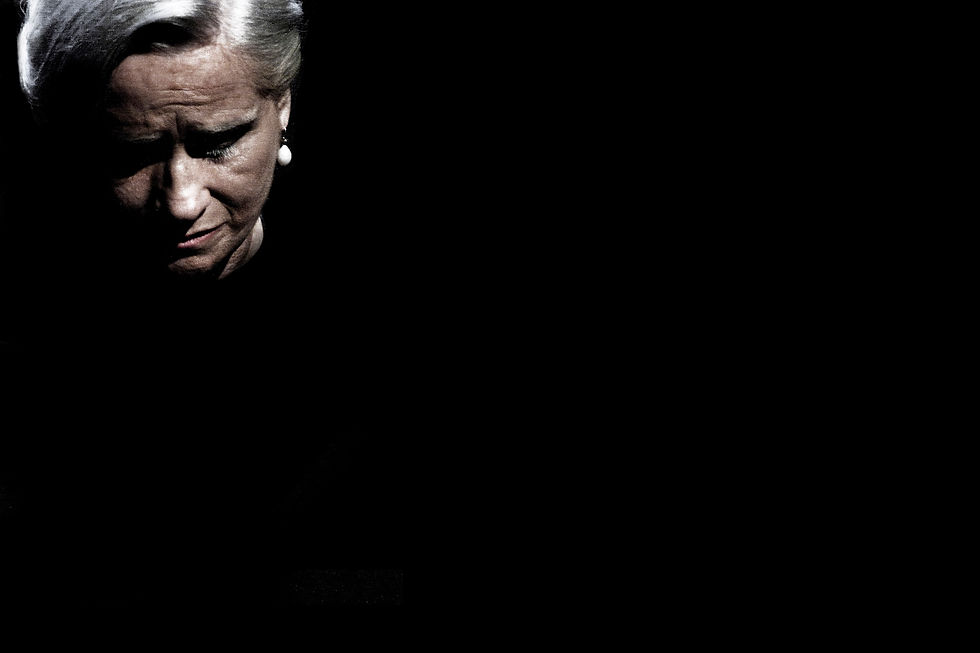
Em Balanço (2001–2011), uma mulher “prematuramente velha” ocupa a cena em absoluta solidão. A voz que se escuta em off — a sua própria — encontra-se descolada do corpo, como se já não lhe fosse possível falar. O movimento contínuo da cadeira de balanço parece ter-lhe confiscado qualquer gesto: ela permanece estática durante quase toda a peça, inclinando levemente a cabeça apenas no instante final.
Nesta obra — como em outras de Beckett — a atriz tem sua centralidade física progressivamente retirada. Aqui, é a palavra que lhe é subtraída. Em seu lugar, instala-se uma exigência radical de atenção e presença: o corpo, ainda que quase imóvel, é convocado a sustentar a cena em estado de vigília plena. Paradoxalmente, é na gravação em off que a atriz recupera centralidade, ao interpretar um texto composto por frases curtas, estruturadas como um poema, que deixam entrever fragmentos da vida e dos afetos dessa mulher.
Elemento visual e narrativo decisivo, a cadeira de balanço foi ressignificada por Adriano e Fernando Guimarães. Em vez da cadeira de madeira pálida, de braços arredondados e acolhedores sugerida por Beckett, os encenadores conceberam uma cadeira preta, de braços retos e verticais, que ocultam em sua estrutura o mecanismo de iluminação do rosto da mulher nas transições entre seções.
Nessas condições, a cadeira adquire feições ambíguas: é berço, mas também armário, também caixão — formas recorrentes ao longo de todo o Projeto Beckett. Esse procedimento, aliás, constitui um dos principais dispositivos ativados pelos diretores em suas montagens do dramaturgo irlandês: por meio da variação e da criação de elementos visuais, infiltram discursos autorais no interior da dramaturgia rigorosamente controlada de Samuel Beckett.
In Rockaby (2001–2011), a “prematurely old” woman occupies the stage in absolute solitude. The voice heard in off—her own—is detached from the body, as if it were no longer possible for her to speak. The continuous motion of the rocking chair seems to have confiscated any gesture: she remains static for almost the entire piece, tilting her head slightly only in the final instant.
In this work—as in others by Beckett—the actress’s physical centrality is progressively withdrawn. Here, it is speech that is taken from her. In its place, a radical demand for attention and presence is installed: the body, though nearly immobile, is summoned to sustain the scene in a state of full vigilance. Paradoxically, it is in the offstage recording that the actress regains centrality, interpreting a text composed of short phrases, structured like a poem, which allow fragments of this woman’s life and affections to surface.
A decisive visual and narrative element, the rocking chair was re-signified by Adriano and Fernando Guimarães. Instead of the pale wooden chair with rounded, embracing arms suggested by Beckett, the directors conceived a black chair, with straight, vertical arms that conceal within their structure the lighting mechanism illuminating the woman’s face during transitions between sections.
Under these conditions, the chair acquires ambiguous features: it is a cradle, but also a wardrobe, also a coffin—recurring forms throughout the entire Beckett Project. This procedure, moreover, constitutes one of the principal devices activated by the directors in their stagings of the Irish playwright: through the variation and creation of visual elements, they infiltrate authorial discourses into the rigorously controlled dramaturgy of Samuel Beckett.
Texto
[Text]
Samuel Beckett
Tradução
[Translation]
Bárbara Heliodora
Direção e cenografia
[Direction and set design]
Adriano Guimarães, Fernando Guimarães
Elenco
[Cast]
Nathalia Timberg, Vera Holtz
Iluminação
[Lighting design]
Dalton Camargos
Figurino
[Costume design]
Ana Miguel
Fotografia
[Photography]
Dalton Camargos, Ismael Monticelli,
Ricardo Junqueira, Thiago Sabino