

Viúva, porém honesta
Widow, but honest
Em Viúva, porém honesta (1997), Adriano e Fernando Guimarães dão continuidade tanto ao diálogo com a obra de Nelson Rodrigues quanto à parceria com o encenador Hugo Rodas na direção. A escolha desse texto reforça o interesse dos diretores por materiais dramáticos nos quais a teatralidade é tensionada como convenção — traço já presente em montagens anteriores — permitindo um tratamento marcadamente alegórico do drama rodrigueano.
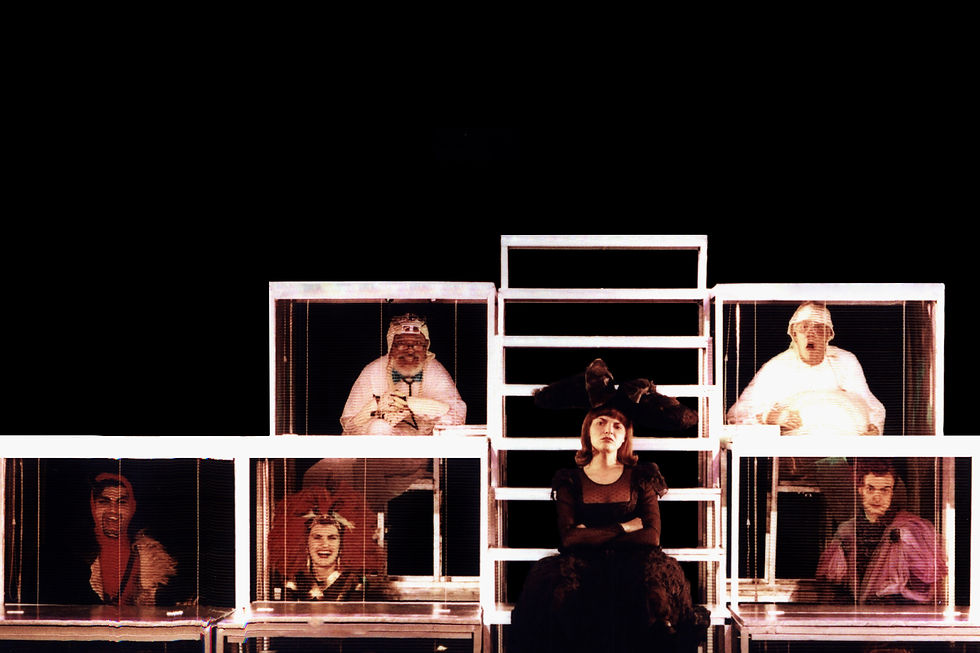
O enredo, que aborda as relações entre sociedade e mídia — bem como os jogos de interesse e conflito por ela desencadeados — é ressignificado na concepção cenográfica: um grande jornal tridimensional, formado por estruturas sobrepostas e margens rigidamente demarcadas. Surgem, assim, edifícios-símbolo: prédio-jornal, prédio-manchete, prédio-fotografia, prédio-hierarquia.
A palavra impressa da manchete é substituída pelos próprios corpos e personagens, enquanto a cenografia assume a função de suporte da linguagem. O estatismo arquitetônico do “prédio” contrasta com a movimentação possível no interior das caixas-manchetes — instaurando tensões entre dentro e fora — e no jogo das persianas, que operam nas chaves de abrir/fechar, revelar/ocultar.
O deslocamento dos atores em relação às caixas dá-se predominantemente no eixo vertical, reforçando no corpo a imponência estrutural do elemento edifício. Esse procedimento confere à encenação uma qualidade anti-naturalista e intensifica o tratamento alegórico da obra.
A contenção do movimento reaparece, assim, como dispositivo central — acompanhada por um desenho rigoroso das ações e da gestualidade das personagens.
In Widow, but honest (1997), Adriano and Fernando Guimarães continue both their dialogue with the work of Nelson Rodrigues and their collaboration with director Hugo Rodas. The choice of this text reinforces the directors’ interest in dramatic materials in which theatricality itself is put into tension as a convention—a trait already present in earlier productions—allowing for a markedly allegorical treatment of Rodrigues’ drama.
The plot, which addresses the relationships between society and the media—as well as the various conflicts and interests they generate—is re-signified through the scenographic conception: a large three-dimensional newspaper, formed by superimposed structures with sharply defined margins. Symbolic “buildings” emerge: newspaper-building, headline-building, photo-building, hierarchy-building.
The printed word of the headline is replaced by bodies and characters, while scenography assumes the role of language support. The architectural statism of the “building” contrasts with the movement permitted within the headline-boxes—establishing tensions between inside and outside—and with the blinds, which operate through the dynamics of open/closed, reveal/conceal.
The actors’ movement in relation to the boxes occurs predominantly along the vertical axis, reinforcing within the body the imposing structural quality of the building element. This procedure confers an anti-naturalistic character to the staging and intensifies its allegorical treatment.
The containment of movement thus reappears as a central device—accompanied by a rigorous design of actions and character gesture.
Texto
[Text]
Nelson Rodrigues
Direção e cenografia
[Direction and set design]
Adriano Guimarães, Fernando Guimarães, Hugo Rodas
Elenco
[Cast]
Adriana Mariz, Adriana Nunes, Alexandre Ribondi, André Amaro, Carmem Moretzsohn, Chico Sant’Anna, Cláudio Falcão, Dora Wainer, Gê Martu, Graça Veloso, Maurício Witczak, Paulo Duro
Figurino
[Costume design]
Lino Villaventura
Iluminação
[Lighting design]
Dalton Camargos
Fotografia
[Photography]
Mila Petrillo